
He Locked the Doors on 40 Years of Work. Didn't Sell. Just Walked Away.
Stu knew a dentist from church in Arizona. Ran a practice for decades. Built something real. Then one Sunday he walked into services and said he'd retired. Stu was excited for him. Asked who he'd sold to.
Nobody. He didn't sell. He just closed the doors.
Stu said he almost cried.
He wasn't being dramatic. He was thinking about the decades of early mornings and hard decisions that went into building a practice worth buying — and the fact that this man had no idea it had a number attached to it. No broker. No conversation. No second opinion. Just a lock on the door and forty years walking out with him.
Jason Morris has heard this story in different forms almost every week since he started looking at founder-built businesses to acquire. Rich Jarvis has spent twenty-plus years in real estate capital and has watched the same thing happen on the property side. Neither of them is shocked anymore. But neither of them is okay with it either.
That's the conversation they came on Startups with Stu to have.
The Whiteboard Week That Started Everything
Rich and Jason didn't meet through a deal. They were introduced through Jason's sister-in-law. Rich was running Epic Capital Funds. Jason had just spent 14 years as a portfolio CEO — the person a private equity firm puts inside a company to run it, hit the metrics, and get it to exit — and was ready to get on the other side of the table.
They flew to Boise. Spent a week in front of a whiteboard. Just the two of them, pulling ideas out of their heads and onto the board, erasing it, starting over, photographing it, going again. All the things they'd each learned the hard way, all the frameworks they'd built separately, all the instincts they hadn't had language for yet — it all went on that board.
Friday afternoon they got in the elevator. Shook hands. Went to the Boise State-Nevada game. Got hot chocolate at Shari's afterward. Impact Equity Partners was born.
What aligned them wasn't the capital structure or the deal thesis. It was something harder to find: a shared view of what business is actually for. The stewardship you carry for employees, customers, vendors. What freedom of purpose means when you've actually built something. You can't manufacture that kind of alignment. You either find it or you don't.
What $830 Million Looks Like From the Inside
Rich started buying real estate in 1998. His first debt fund was 2004. Between 2008 and 2011, he lost everything. Multiple properties. A couple of airplanes. Three years to sell off every asset. He talks about it plainly: it was hard. It taught him things he couldn't have learned any other way.
Epic Capital Funds launched five years ago, initially as the capital arm of a development company. Within the first year Rich bought out the partners and took it independent. Today: $830 million in assets under management, $3.4 billion in the pipeline over the next 18-24 months.
For founders who haven't spent time in this world, those numbers need translation. Assets under management is the total value of all the projects currently in play. Pipeline is the estimated project costs of deals that are in process but haven't closed yet. Not all of that pipeline goes through. Entitlement alone on a Lake Tahoe hotel project they're working on took nine years — it's the first hotel to be approved in Tahoe City in over sixty years. Some deals die in due diligence. Some don't pencil. You have to have the discipline to walk away even after spending real money to get there.
The lesson Rich would give any founder thinking about scale: the most important time he spends each week is away from his desk. He calls them clarity breaks. Out of the office, asking himself two questions: what do I need to start doing, and what do I need to stop doing. Not every week brings a big answer. But without that space, you end up stuck in the weeds, unable to see the business from above it.
The Buy Box and the 3,000 Companies
Jason spent 14 years as a portfolio CEO before starting Impact Equity Partners. The job, for anyone unfamiliar: you're the operator a PE firm puts inside an acquired company to run it day-to-day. Hit the metrics. Manage the debt. Scale it. Get it to an exit. He did that across multiple companies over more than a decade, accumulating, in his words, battle wounds, scars, and sleepless nights of trying to figure out how to get through the hard.
Now he's the buyer. And he and Rich have reviewed over 3,000 companies this year alone.
Early on, they cast wide. Deals in Maine, Oregon, Florida, Texas. They were hungry and the buy box was loose. A few months of that taught them what any serious acquirer eventually learns: discipline is the competitive advantage. You don't get better by looking at more deals. You get better by getting very specific about what you're actually looking for and saying no to everything that doesn't fit.
Their target: cash-flowing businesses, ten years or older, that have stood the test of time without necessarily optimizing for growth. The ones where the founder spent the last decade on a comfortable cruise speed — making good money, not reinvesting aggressively, not pushing for the next level. Lifestyle businesses. The ones where, with a little capital, the right leadership, and some AI-assisted efficiency, you can move the needle fast.
First acquisition: a hypoallergenic adhesive manufacturer in Oregon. Biggest customer base: the gel nail and acrylic nail industry. They bought it knowing they wanted to branch into other verticals and launch a direct-to-consumer brand. Instead of spending years building that DTC brand from scratch, they found one already operating in Arizona that their manufacturer already supplies — and they're merging it in. That's a bolt-on. Year three of DTC revenue, accelerated to year one.
Currently under contract: an HVAC company and three non-emergency medical transportation companies that they'll merge into a centralized dispatch operation, with an auto repair company lined up to service the fleet.
Revenue Is the Wrong Number to Watch
One of the sharpest moments in this episode wasn't about a deal. It was about metrics.
Rich made the point simply: when companies focus on revenue instead of profit, every employee is optimizing for the wrong thing. A salesperson chasing revenue will close deals that cost more to fulfill than they earn. They won't know they did it. Nobody will. Until you look at the profit line and realize you've been busy and broke at the same time.
When profit becomes the shared metric, the whole team realigns. They start asking different questions about what it costs to produce, what they're commissioning, what the margin actually is on each customer relationship. Some customers, it turns out, cost more than they pay. Not every business has the courage to audit that list and say goodbye to the ones dragging the number down.
Jason calls it the lever of control. Find your niche. Know your margins. Stay disciplined enough to get rid of what doesn't serve you. It sounds simple. It's one of the hardest things a growing company actually does.
The Second Bite and the Dentist's Lost Exit
The saddest story in this episode is a short one.
Stu's dentist friend didn't know his practice was a sellable asset. He built it over decades, made a good living, and when he was done, he locked the door. No broker conversation. No valuation. No deal. Just gone.
Jason and Rich have structured their acquisition approach specifically to make sure that doesn't happen to the people they work with. They call it the second bite of the apple. When they buy a business, they build deal structures that let the founder retain a piece of the equity going forward — so when Jason and Rich grow the business and sell it in five to ten years, the original founder gets another payday on top of what they already received at closing.
It's not just generosity. It's alignment. You want the person who built the thing to care about what happens to it next. And it honors something real: those relationships, that reputation, those forty years of early mornings — they have value that deserves more than a locked door.
Rich's goal is to impact 5,000 lives through what he builds. Jason measures his success by whether his relationships stand the test of time — the people he was in the trenches with, still rubbing shoulders with at 80 and 90.
Tim McGraw's "Standing Room Only" came up. Go listen to it. The point is hard to argue with.
What Stuck With Me
This is a different kind of episode for Startups with Stu. Rich and Jason aren't scrappy first-time founders figuring things out in real time. They've been through it. They've lost everything and started over. They've run other people's companies and built their own. They've sat across from thousands of founders trying to figure out whether to buy what those founders built.
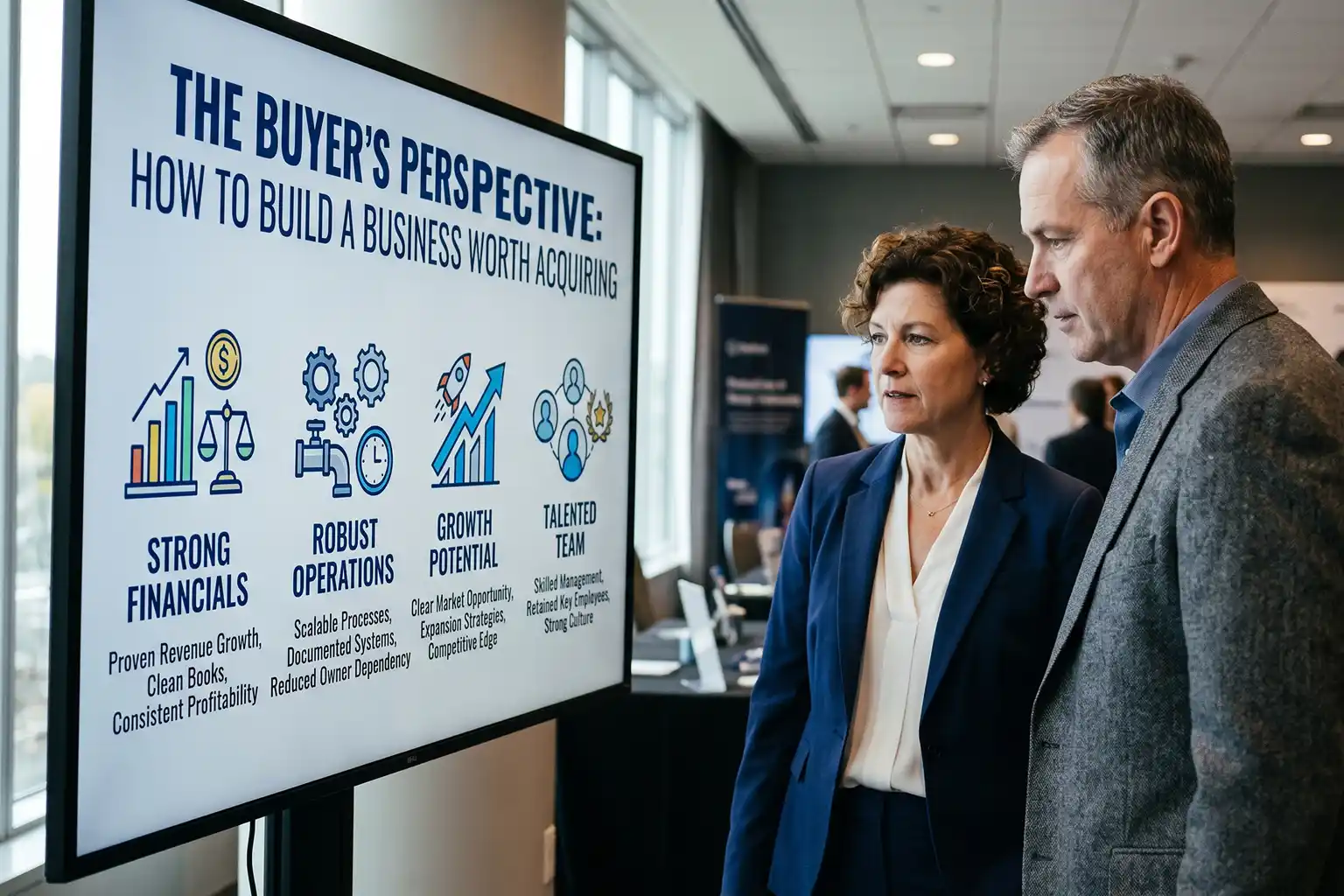
What they've learned, distilled down: money is a tool, not the goal. Relationships are the compound interest that actually builds wealth over a lifetime. The right partner is worth more than the best deal. And every founder who's grinding right now toward some future exit should understand — someone like Rich and Jason is watching. The businesses that have stood the test of time, that have cash flow and reputation and a decade of proof — those are exactly what capital is looking for.
Build something worth buying. Then actually sell it.
Don't lock the door.
Recorded live at a Startups with Stu retreat. More at startupswithstu.com.
Related blogs


Subscribe for Updates
Subscribe to the Startups With Stu newsletter and get advice and stories sent straight to your inbox to help launch your business to the moon!
Comments